


A mobile notary travels to a client's location for in-person signings, whereas an online notary uses video technology to complete the process remotely. The choice between a mobile notary vs online notary Texas typically depends on whether the document requires a physical wet-ink signature or if the signer prefers the speed and convenience of a digital format. While online notarization is often more efficient, mobile services remain necessary for individuals without internet access or when dealing with specific paper-only legal requirements.
Navigating the logistical hurdles of document certification in the Dallas-Fort Worth metroplex often leads to a pivotal question for professionals and families alike. Should you schedule a mobile notary to meet at your office, or is a Remote Online Notarization (RON) session the more efficient path forward? While Texas remains a pioneer in digital signatures, the choice between these two methods is rarely about convenience alone; it is about ensuring legal compliance and document acceptance. At DFW Apostille & Notary Services, we understand that selecting the wrong format can lead to costly delays, particularly with sensitive real estate deeds or international apostille requirements. This guide examines the critical differences between mobile and online notary services in Texas. You will learn when a wet ink signature is non-negotiable, how RON provides modern flexibility, and which solution aligns with your specific legal or financial needs.
The Evolution of Notarization in the Lone Star State
Texas has established itself as a national leader in the modernization of notarial acts. By being one of the first states to implement comprehensive legislation for digital signatures, the Lone Star State paved the way for both traditional face to face meetings and advanced virtual sessions. The Texas Secretary of State (SOS) maintains strict oversight for both traditional mobile notaries and those authorized to perform Remote Online Notarization (RON). This dual system ensures that every signature, whether applied to physical paper or a digital file, carries the full weight of the law.
While both methods result in a legally binding notarization, the choice between them is rarely about legality and more about the specific requirements of the receiving party. Factors such as document type, processing urgency, and the physical location of the signer dictate the best path forward. DFW Apostille & Notary Services provides a comprehensive suite of options, including mobile notary services for high stakes signings in Arlington and Mansfield, as well as RON for global clients. We also handle specialized needs like jail and inmate notarizations and Texas and federal apostille facilitation. By offering both traditional and digital avenues, we ensure every client receives the specific authentication method required for their transaction.
What is a Mobile Notary and Why Choose One in DFW?

A mobile notary is a commissioned professional who travels directly to a client’s preferred location to perform notarial acts. In the Dallas Fort Worth metroplex, this service bridges the gap for individuals who cannot easily visit a traditional office or who require the physical handling of original documents. When evaluating the choice between a mobile notary vs online notary Texas, the decision often centers on the necessity of wet ink signatures and physical paper processing.
In communities like Arlington, Mansfield, and across Tarrant County, mobile services provide a critical human element. There are specific environments where digital solutions are impractical or prohibited. For example, a mobile notary can facilitate urgent medical directives at Texas Health Arlington Memorial or finalize professional contracts at a home office in Grand Prairie. Furthermore, specialized legal needs often require a physical presence, such as jail and inmate notarizations at Tarrant County correctional facilities in Fort Worth, where electronic devices and internet access for signers are strictly restricted.
Mobile notary services remain essential for documents that must retain a traditional physical format. This includes paperwork requiring embossed seals or specific ink stamps that digital certificates cannot replicate. The physical presence of the notary allows for a thorough, in person verification of the signer’s identity and willingness, providing an additional layer of security for high stakes transactions. While digital options offer speed, the mobile model ensures that those with technology barriers or strict physical document requirements still have access to reliable, professional authentication.
Remote Online Notarization (RON): The Modern Texas Standard
Texas law defines Remote Online Notarization (RON) as a notarial act performed via two-way audio-video technology. While it replaces the physical conference table with a secure digital platform, the legal scrutiny remains rigorous. Under the Texas Government Code, a notary must be physically located within the borders of Texas at the time of the act, though the signer may be located anywhere in the world. This allows a client in Arlington to facilitate a signing for a business partner in London or a family member stationed overseas.
To understand how does online notary work, one must look at the multi-layered security protocols required by the state. Before the video call begins, signers undergo a two-part identity verification process. First, credential analysis uses automated software to confirm the authenticity of a government-issued photo ID. Second, Knowledge-Based Authentication (KBA) requires the signer to answer a series of questions generated from their personal credit and public record history within a strict time limit. This process ensures that the person on the screen is exactly who they claim to be before the notary even opens the session.
During the live recorded session, the notary and signer interact in real time. Rather than using a rubber stamp, the notary applies a digital certificate and an encrypted electronic seal. These tools create a tamper-evident seal on the digital file. If any part of the document is altered after the notarization is complete, the digital certificate will indicate that the integrity of the file has been compromised. When evaluating a mobile notary vs online notary Texas, the primary technological distinction is this digital trail, which offers an advanced level of fraud prevention and document security for electronic transactions.
Key Differences: Mobile Notary vs Online Notary Texas
Choosing the right method requires a look at the specific logistics of your transaction. While both mobile notary services and Remote Online Notarization (RON) are legally valid in the Lone Star State, their execution differs significantly in terms of technology and physical requirements.
Feature | Mobile Notary Services | Remote Online Notary (RON) |
|---|---|---|
Signature Type | Physical Wet Ink | Electronic/Digital Signature |
Verification | In-person ID inspection | KBA and Credential Analysis |
Presence | Physical Appearance | Virtual Appearance |
Primary Fees | Notary Fee + Travel Fee | Notary Fee + Platform Fee |
The mobile notary vs online notary Texas debate often comes down to accessibility. RON offers unmatched speed for tech-savvy signers, yet it relies heavily on stable internet and the ability to pass Knowledge-Based Authentication (KBA). For elderly signers who may struggle with complex digital platforms, or individuals in Tarrant County facilities where WiFi is restricted, the mobile option remains the only viable choice.
Logistically, the cost structure also shifts. Mobile services incorporate travel fees based on distance and time, whereas RON involves platform fees to cover the encrypted audio-video technology. While online is frequently faster for simple forms, a mobile professional is essential when technology is a barrier or when the receiving agency explicitly demands a physical, ink-signed original. This is particularly common in complex estate planning or real estate transactions involving specific county clerk preferences.
When a Mobile Notary is Essential: Wet Ink and International Requirements
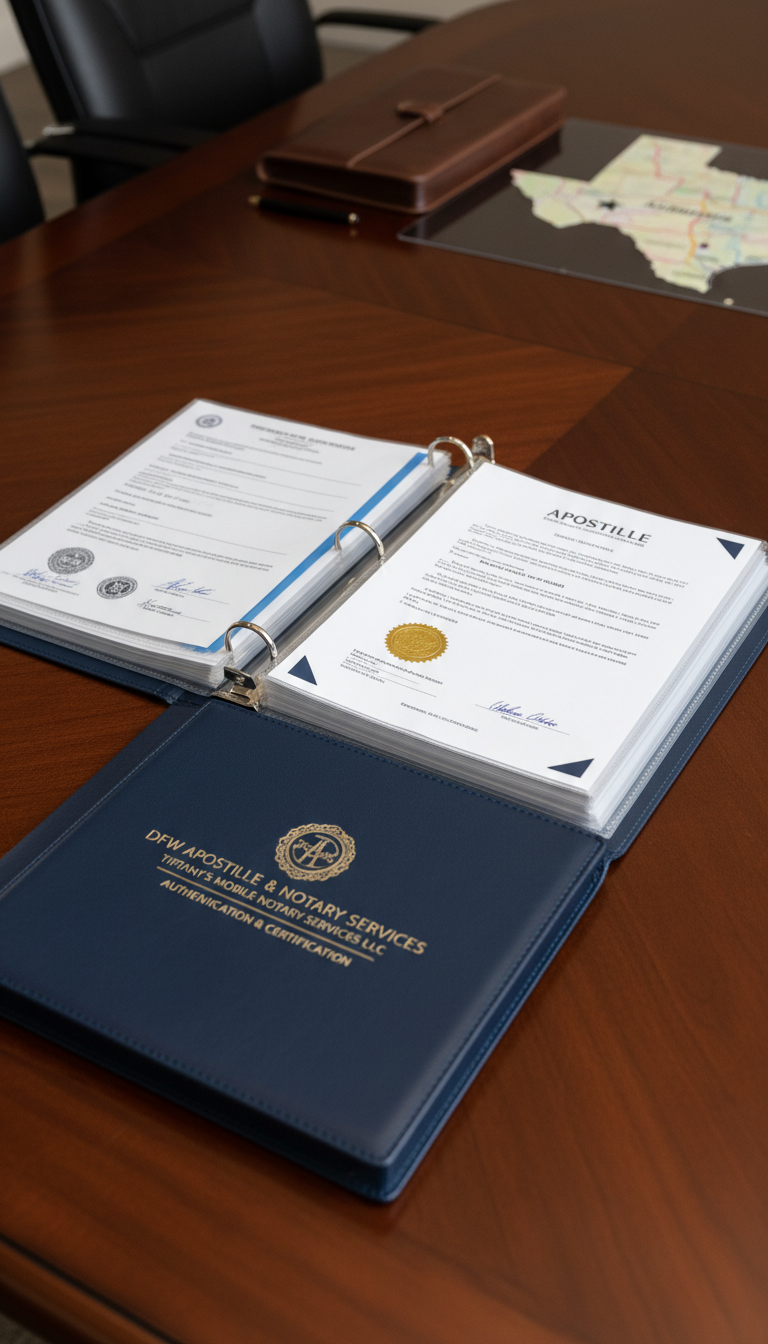
Building on the logistical differences, certain legal and international protocols make physical presence a non-negotiable requirement. For Texas and federal apostille facilitation, the physical integrity of the document is often paramount. The Texas Secretary of State and the U.S. Department of State frequently require a traditional wet ink signature and a physical, inked stamp to verify a notary's commission. Digital signatures generated through Remote Online Notarization (RON) can be rejected by foreign consulates or government agencies in countries that have not yet modernized their legal frameworks to accept electronic records. If a document is destined for a nation that is not a member of the Hague Evidence Convention, a digital seal may result in an immediate rejection of the authentication chain.
Local real estate transactions also hinge on the specific preferences of county officials. While Texas law is progressive, some county clerks in the DFW area still prefer or strictly require physical paper filings for property deeds and specific land records. In the comparison of mobile notary vs online notary Texas, the mobile option is essential whenever a transaction involves a chain of custody for a physical piece of paper. Utilizing mobile notary services ensures that the document meets the stringent standards for wet ink authentication, preventing costly delays in international business or local property recording.
What Documents Cannot Be Notarized Online in Texas?
While Texas law is remarkably flexible regarding Remote Online Notarization (RON), certain documents still demand a physical presence. Historically, Wills and Codicils were excluded from RON. Although statutes have evolved to allow digital estate planning in specific circumstances, many legal practitioners and banks still insist on traditional signatures to prevent future probate disputes or fraud. Furthermore, federal agencies, certain financial institutions, and specific title companies may explicitly mandate an "in-person" appearance for complex real estate transactions or high-value transfers that require a tangible chain of custody.
Staying current on Texas legislation is vital for document security. Texas Senate Bill 693, which takes effect in September 2025, introduces stricter penalties for improper notarial acts. This shift highlights the state's commitment to document integrity, making the choice of mobile notary vs online notary Texas even more critical for sensitive filings. If a receiving party or a specific Tarrant County court requires a wet-ink original, opting for mobile notary services remains the most reliable path to ensure the document is not rejected later for technical non-compliance.
Is Online Notary as Good as In Person?

Texas law is unequivocal on this point; a Remote Online Notarization (RON) possesses the same legal standing as an in person notarization. Per the Texas Government Code, a digital certificate and encrypted seal are just as valid as a physical rubber stamp. Beyond state borders, the Full Faith and Credit clause of the U.S. Constitution provides a framework where states generally recognize the notarial acts performed in other jurisdictions, provided they comply with the laws of the originating state. This means a RON performed by a Texas notary for a signer in another state should be legally recognized across the country.
Despite this legal parity, the practical application of mobile notary vs online notary Texas services depends on the specific acceptance criteria of your document's recipient. A title company might mandate wet ink signatures for certain mortgage documents, or a foreign consulate may require traditional ink for Texas and federal apostille facilitation. Before choosing a remote session, confirm the requirements with the receiving court, bank, or government agency. Legal equivalence does not always guarantee administrative acceptance, so verifying these details upfront prevents unnecessary delays.
Deciding between mobile and online notarization depends on your specific needs, document types, and scheduling preferences. Both methods provide secure ways to finalize your legal paperwork in Texas. If you want expert help choosing the most efficient path for your situation, working with a professional can save you significant time. Our team is available to assist you as a Mobile Notary Public whenever you require reliable, on-site support. We ensure that every document meets the necessary legal standards for your peace of mind.